By Samuel A. Bakutana, CEO Inspired Leaders International, and National Chair / Country Lead for the International Association of Facilitators (IAF) Uganda Chapter.

INTRODUCTION
I write this during International Facilitation Week 2026 — a global celebration of the art and science of facilitation. Across continents, facilitators are helping organizations unlock collaboration, accelerate transformation, and build cultures of trust. Yet, too often, facilitation is misunderstood, undervalued, or confused with training, lecturing, or consulting.
The truth is clear: facilitation is the invisible architecture of collective progress. It is the craft of guiding groups to discover, decide, and commit together. For HR leaders, People & Culture managers, and Learning & Development Officers, facilitation should never be a luxury; it is a strategic investment. Research shows that organizations with strong facilitation practices report about 30% higher employee engagement and 25% faster decision-making cycles (Gallup Workplace Study, 2024).
THE 10 REMINDERS FOR HUMAN RESOURCE LEADERS:
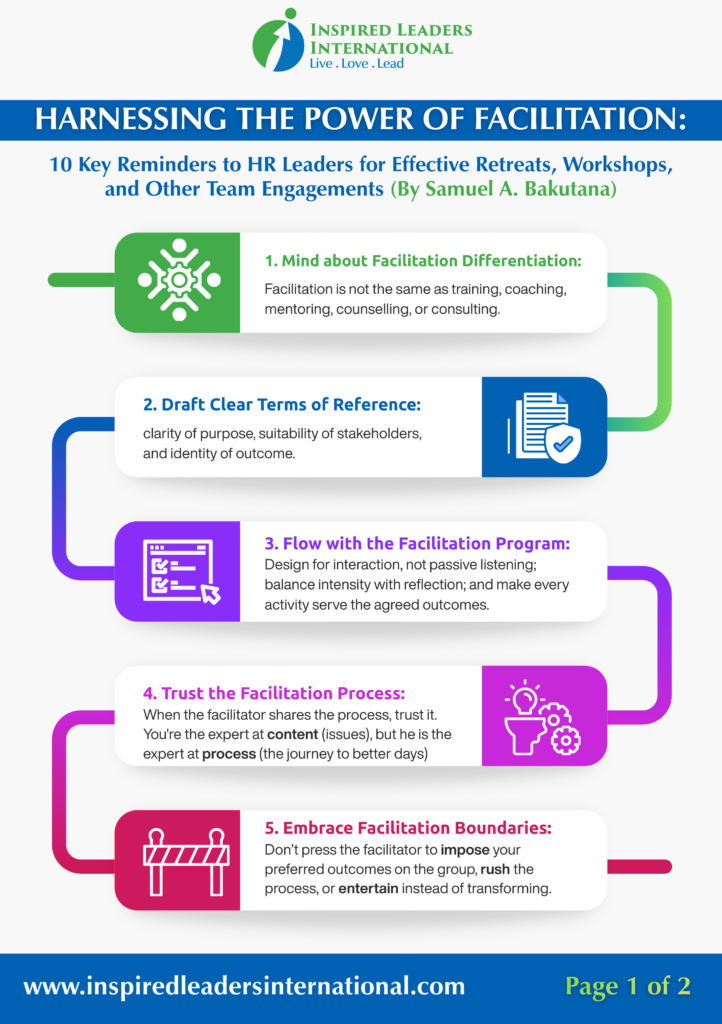
1. Mind about Facilitation Differentiation:
Facilitation is not the same as training, coaching, or consulting. Training mostly transfers knowledge and skills. Coaching is a thought-provoking growth partnership that mostly unlocks individual potential. Consulting provides expert solutions. (We could add mentoring which is about experience sharing and counselling which majorly deals with therapeutic, options-exploring, psychosocial support).
Facilitation, however, is a process-based engagement that guides collective intelligence, helping groups co-create solutions they own. McKinsey (2025) found that teams involved in facilitated decision-making are 40% more likely to implement solutions effectively compared to consultant-driven recommendations.
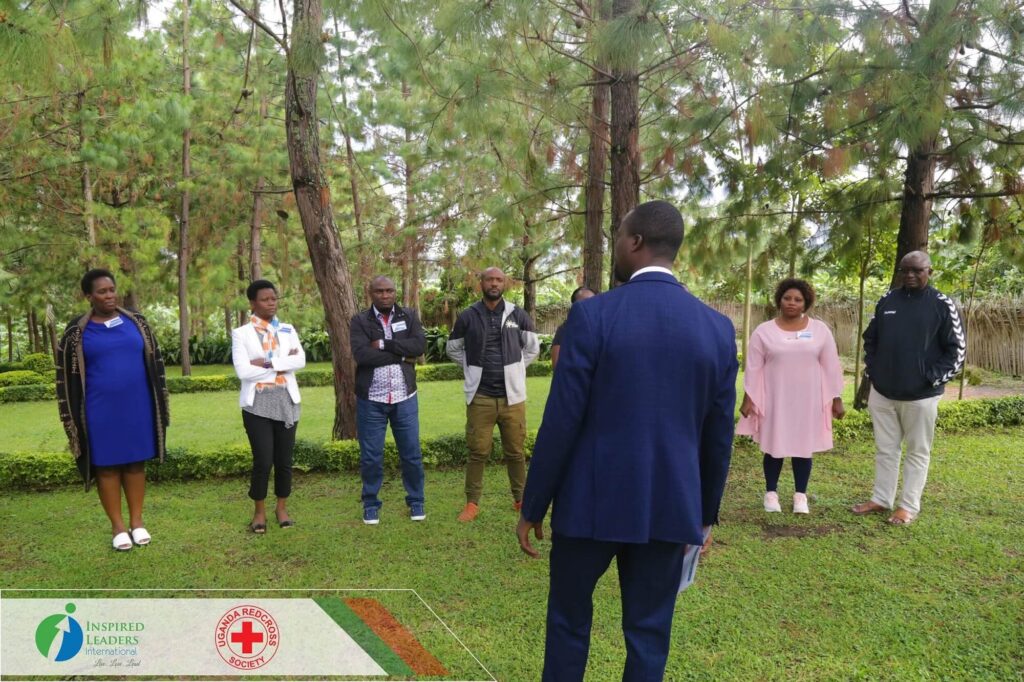
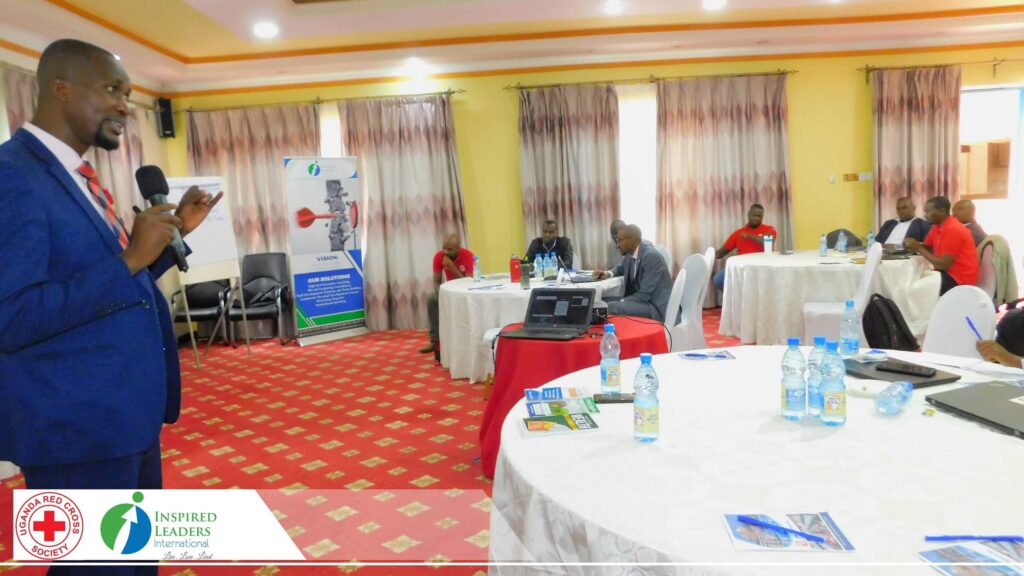
So, as I clarified during the IAF Africa Conference 2025 in Arusha Tanzania, do not confuse the different “hats” by asking for a facilitator when you mean a consultant or a mentor – or even a comedian for your End-of-year Party!
2. Draft Clear Terms of Reference:
When drafting Terms of Reference (TORs) or Request for Proposals (RFPs) for facilitators, consider three issues: First, clarity of purpose: What specific transformation do you really want to trigger? Second, suitability of stakeholders: Who must / should be in the room? Third, identity of outcome: How will success look like? A poorly written TOR leads to mismatched expectations, but a precise TOR ensures alignment and increased possibility for a higher ROI. Clarity increases productivity.
3. Flow with the Facilitation Program:
At execution, the program of the day(s) must respect three facts: First, adults learn by doing; so, allow the facilitator to design the sessions for interaction, not passive listening. Second, energy is currency; so, the sessions must balance intensity with reflection. Third, time is sacred; so, every activity must practically serve the agreed outcomes. According to Deloitte Human Capital Trends (2025), 72% of employees disengage when workshops are overly theoretical.
This explains why, at Inspired Leaders International, we often engage the clients to reduce the number of official speeches and limit the mid-program interruptions – especially in government institutions – so that er together focus on the practical objective of the engagement.
4. Trust the Facilitation Process:
When the facilitator shares the process, trust it. Facilitators (especially if you got a professional, excellent one) are architects of flow. Their sequence of activities is usually intentional, built to move participants from divergence (many ideas) to convergence (shared understanding and/or decisions), based on the “group process facilitation” tenets.
That’s why, whereas facilitators too are flexible enough to co-create with you, trying to interfere with the process midstream often will often derail momentum. It’s better to trust the facilitator’s process. Yes, you’re the expert at the content (issues at hand), but he is the expert at the process (the journey to better days ahead).
5. Embrace Facilitation Boundaries:
It is important that you do not press facilitators to do these three things: First, as a client contact person, do not press the facilitator to impose your preferred personal outcomes on the group because facilitation is about guided discovery, not pre-determined dictation — no matter the clarity of objective. Secondly, don’t rush the process because speed without depth leads to shallow commitments. That’s why each session should be given sufficient time to meaningfully let the process organically marinate the engagement into a beautiful tapestry. Thirdly, don’t press the facilitator to entertain instead of transforming because facilitation is not performance; it is purposeful engagement. For entertainment, a professional comedian or music artist might do a better job.
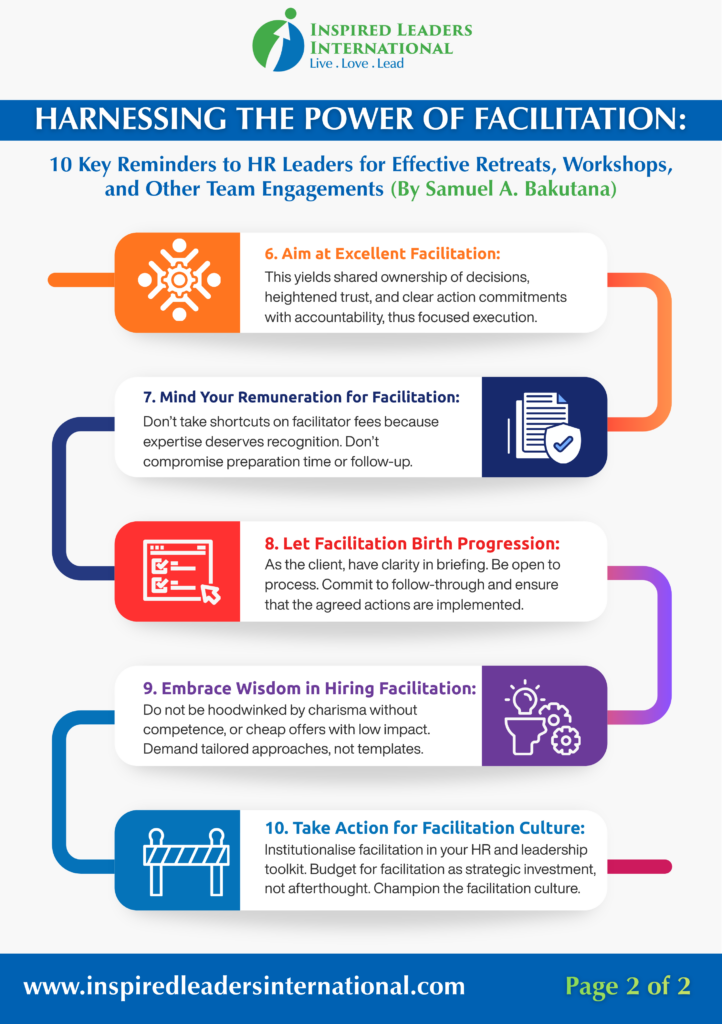
6. Aim at Excellent Facilitation:
When facilitation is done excellently, three things happen: First, there’s shared ownership of decisions, thereby increasing the implementation quotient. Secondly, you achieve heightened trust among participants, thereby deepening cohesion. Thirdly, you garner clear action commitments with accountability, thereby achieving focused execution. This explains why a Harvard Business Review study (2023) revealed that facilitated retreats increase team trust scores by 32% compared to non-facilitated meetings. It’s worth it.
7. Mind Your Remuneration for Facilitation:
Great facilitation requires respectful financial investment. On that note, do not take shortcuts on facilitator fees because expertise deserves recognition. Secondly, do not compromise preparation time since designing a tailored process takes effort. Also, do not underrate the power of post-engagement follow-up because without it, insights often fade.
Therefore, as you budget for the hotel / venue, the 5-course meals for the team, the transport, among others, please ensure that you budget generously for the facilitator(s). The Association for Talent Development (ATD, 2024) found that every $1 invested in professional facilitation yields $4.50 in ROI through improved collaboration, reduced conflict, and increased productivity.
8. Let Facilitation Birth Progression:
As the client, equip yourself with three abilities: First is the clarity in briefing wherein you should state your expectations clearly. Second is openness to process; as said above, trust the facilitator’s craft. Third is commitment to follow-through; ensure agreed actions are implemented. These are important abilities you need as you lead people development efforts in your entity.
9. Embrace Wisdom in Hiring Facilitation:
Anybody can call themselves a facilitator. Do not be hoodwinked by these three things when hiring facilitators: First is charisma without competence; look beyond personality. Second are the cheap offers; let me tell you straight that low cost often means low impact — period. Thirdly, to slow on generic methods, but demand tailored approaches, not copy-paste templates. Hopefully that won’t mean micromanaging the facilitator’s process instead of giving him the freedom to design a professional journey for the team.
10. Take Action for Facilitation Culture:
Going forward, take three actions: First, institutionalize facilitation in your HR and leadership toolkit. Secondly, budget for facilitation as a strategic investment, not an afterthought. Third, champion facilitation culture by not only engaging external facilitators but also training managers to adopt facilitative leadership styles as they go about their day-to-day assignments within. That’s why the World Economic Forum (2025) identified facilitation and collaboration among the top 10 skills for future leaders.
CONCLUSION:
Facilitation is neither about “running a meeting” nor “talking to people.” Instead, it is about unlocking collective wisdom in the room, accelerating decision-making, and embedding accountability.
In this Facilitation Week 2026 — and beyond, I challenge HR leaders, CEOs, and People & Culture managers to stop treating facilitation as optional, and start seeing it for what it is — an engine of transformation.
When you hire a professional facilitator, remunerate them with respect. When you design retreats, workshops, or team building engagements, treat facilitation as the strategic lever for ROI. And when you lead, remember: the best leaders are facilitators of collective progress.
Live. Love. Lead.